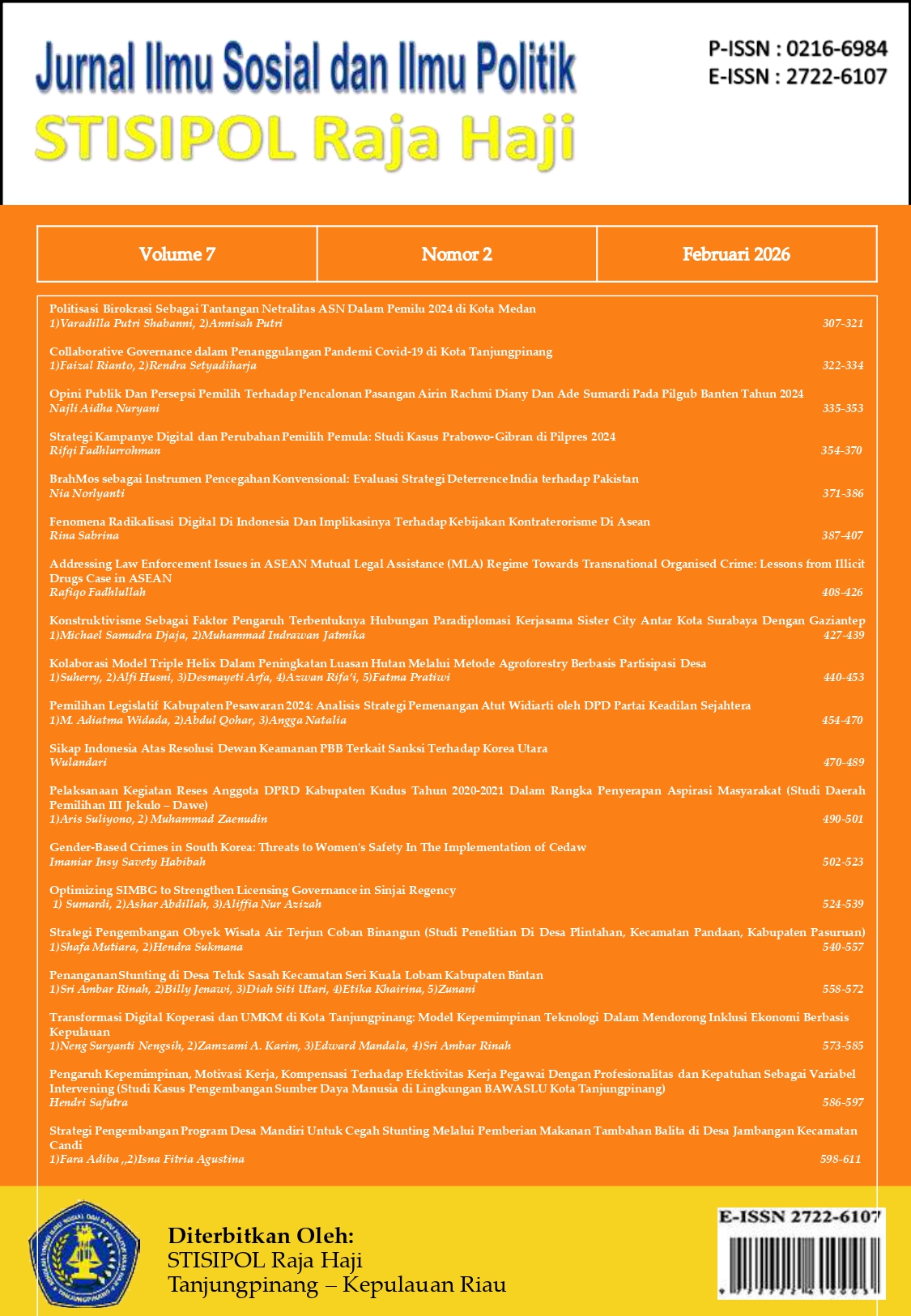
Addressing Law Enforcement Issues in ASEAN Mutual Legal Assistance (MLA) Regime Towards Transnational Organised Crime: Lessons from Illicit Drugs Case in ASEAN
DOI:
https://doi.org/10.56552/jisipol.v7i2.332Keywords:
Illicit Drugs, Regime, ASEAN Mutual Legal AssistanceAbstract
Transnational organised crime in Southeast Asia, particularly illicit drug trafficking, continues to escalate despite
ASEAN cooperation frameworks. Although mechanisms such as the ASEAN Ministerial Meeting on
Transnational Crime and the Mutual Legal Assistance Treaty (MLAT) exist, law-enforcement coordination
remains weak, resulting in ineffective cross-border investigation and prosecution. Previous studies discuss
ASEAN security cooperation but have not adequately examined how institutional capacity, compliance gaps, and
divergent legal systems constrain the effectiveness of MLA. Moreover, Regime Theory has not been used to
evaluate MLA in illicit-drug cases, leaving an analytical gap regarding its structural and functional
limitations.This article offers a novel contribution by integrating Regime Theory with regional institutionalism
to evaluate ASEAN’s MLA regime through the dimensions of problem structure, institutional capacity, resource
availability, and compliance mechanisms. The objective of this study is to assess why ASEAN’s MLA framework
needs to be expanded and deepened to resolve persistent law-enforcement challenges in countering transnational
organised crime, particularly illicit drugs. This research employs a qualitative method using primary ASEAN
legal documents, treaty instruments, and secondary scholarly analyses. The findings show that ASEAN’s MLA
regime remains constrained by fragmented legal harmonisation, weak compliance enforcement, insufficient
institutional capacity, and unequal resources among member states. These weaknesses hinder evidence sharing,
delay cross-border investigations, and produce inconsistent prosecutorial outcomes. The study concludes that
strengthening MLA requires deeper harmonisation of procedural rules, enhanced institutional coordination,
capacity-building initiatives, and future development of a region-wide extradition mechanism.
Downloads
Published
How to Cite
Issue
Section
License
Copyright (c) 2026 Jurnal Ilmu Sosial dan Ilmu Politik

This work is licensed under a Creative Commons Attribution 4.0 International License.